Oxygen Absorbers vs Desiccant Packs for Freeze Dried Candy
Understand moisture control, oxygen control, packet compatibility, and the questions to ask before packaging freeze-dried candy.
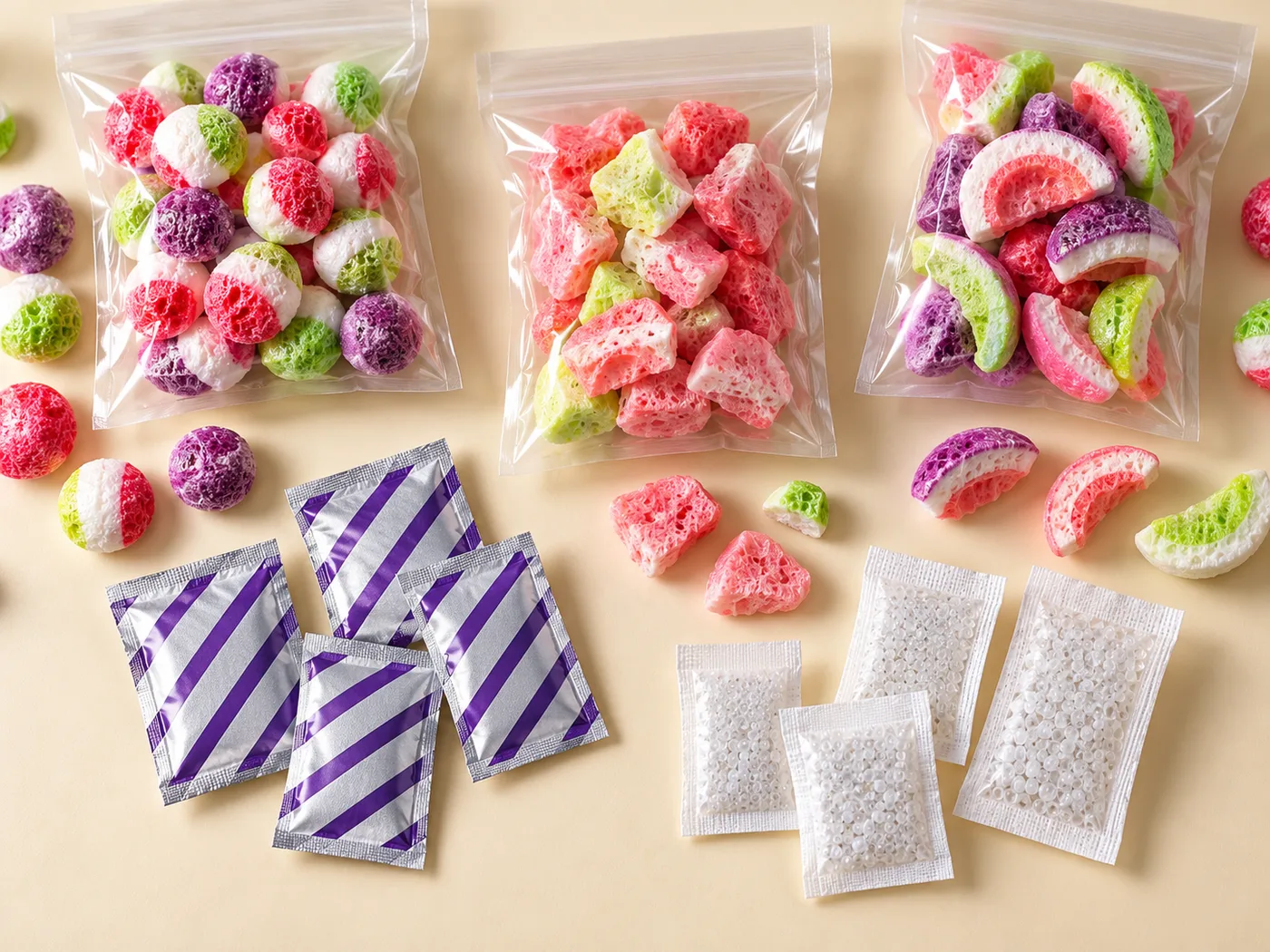
Ask a group of freeze dried candy sellers which packet goes in the bag and you will get three confident answers. Oxygen absorbers. Silica packs. Both. The trouble is that these two packets do opposite jobs, and using the wrong one does not just waste money. It can leave your candy unprotected while you think it is covered.
Here is what each one actually does, which one candy needs, and how to size it.
The two packets do different things
An oxygen absorber removes oxygen from the air inside a sealed package. Most are filled with iron powder. The iron reacts with oxygen and turns to iron oxide, which pulls the oxygen level down. That protects food from oxidation, the process that turns fats rancid and fades flavors and colors over months.
A desiccant pack removes moisture. Most are silica gel, tiny beads with an enormous surface area that pull water vapor out of the air inside the package and hold onto it. That protects food from humidity, the thing that turns crunchy candy soft, sticky and chewy.
Oxygen and moisture are different enemies. A packet that fights one does nothing about the other.
Why candy is a special case
Most freeze dried candy is sugar, air and flavor. There is very little fat in a Skittle, a taffy piece or a marshmallow, so oxidation is a minor threat. The enemy that ruins candy is moisture, and it is not close. Candy comes out of the freeze dryer almost completely dry and starts pulling water from the air the minute the door opens. That is why a batch can be crunchy at bagging and soft a week later.
There is a second catch with absorbers: their formulation matters. Some depend on moisture in the package; others are designed for low-moisture foods. Do not assume every absorber will work the same way in very dry candy. Ask the supplier whether the exact product is appropriate for your candy and compatible with any desiccant you plan to use.
Meanwhile the job that actually needed doing, keeping the air inside the bag dry, never got assigned to anything.
So which one goes in the bag?
For moisture-sensitive candy, moisture control is a key part of protecting texture. A food-contact desiccant may be useful in a properly sealed barrier package, but packet selection should follow the supplier’s guidance for the actual product and storage conditions.
That does not make oxygen absorbers useless. It makes them situational:
- Long storage in mylar. If bags will sit for months before selling, an absorber adds a second layer of protection against slow flavor and color fade, as long as the bag is a real barrier bag and the seal is solid. In a thin or leaky bag, oxygen seeps in faster than any absorber can remove it, and the absorber is wasted.
- Candy with fat in it. Freeze dried ice cream, cheesecake bites and anything chocolate coated has fat that can oxidize. For those, an absorber earns its place, with the desiccant still doing the moisture job.
- Deli containers at markets. Skip the absorber. Containers get opened all day, and an absorber exhausts itself fast once air keeps coming in. A desiccant helps a little between openings, but a container that opens fifty times a day is a short term display tool, not storage. Sell from the container, store in sealed bags.
What size desiccant pack to use
Desiccant packs are often sold by weight, but bag dimensions alone do not establish the correct amount. Package volume, headspace, moisture barrier, initial product condition, humidity, and intended storage time all affect the choice. Use the packet manufacturer’s sizing guidance for your specific application rather than a universal grams-per-bag table.
If candy goes soft, check the drying process, time exposed to room air, package barrier, and seal before simply increasing the packet size.
Two handling rules matter more than the exact gram. First, only use packets sold as food grade, and keep them clean and dry until they go in. Second, work fast at bagging time. Desiccant packs start drinking room air the moment they are out of their sealed packaging, and so does your candy. Bag, packet, seal, in that order, without a long pause in the middle.
Do not apply a universal oven temperature to used packets. Regeneration instructions depend on the desiccant and packet material; reuse a packet only if its manufacturer specifically permits it for that application and provides instructions. Treat oxygen absorbers as single-use and follow the supplier’s handling and storage directions.
The mistakes that make packets useless
Bagging candy that is not fully dry. No packet rescues wet candy. A desiccant buys time for properly dried candy; it cannot finish the freeze dryer's job. If the centers are still soft, the batch needs more dry time, not a bigger packet.
Trusting the absorber to keep candy crisp. It does not touch moisture. This is the single most common mix-up in the groups, and it is why so many sellers swear they "used the packet and it still went soft."
Putting an absorber in a container that keeps opening. It exhausts, then it is just paper and iron taking up space.
Using bargain bags with a good packet. Packet choice only matters inside a package that actually seals and blocks air. A quality mylar bag is part of the same system, which is worth remembering when you write your candy packaging brief before ordering bags. A strong packet in a weak bag loses slowly and quietly.
A simple rule to work by
Ask what you are protecting against. If the answer is soft, sticky or chewy, that is moisture, and the answer is a desiccant in a well sealed bag. If oxygen control is also needed, select an absorber suited to the food and package, and confirm compatibility before combining packets. And if candy keeps dying in the bag, check the dryness and the seal before you spend one more dollar on packets. Supplies are the last step of the system, not the first. A simple inventory and reorder system helps you keep the right packets on hand once you know which ones your products actually need.
Quick questions
Can I put both packets in one bag? Sometimes, but compatibility is product-specific. Some oxygen absorbers need moisture and can be hindered by a desiccant. Other formulations are designed to work in dry conditions. Get guidance for the exact packet combination before using both.
Do I legally have to put a packet in to sell? Do not use a packet recommendation as a substitute for checking the rules that apply to your product and business. Confirm product eligibility, packaging, labeling, and any process requirements with the relevant authority.
The packet says do not eat. Is it safe touching food? Use only an intact packet specifically sold as suitable for direct contact with the food you package. Follow its supplier’s conditions of use. The contents are not food; do not use damaged packets or repurpose packets from unrelated products.
My candy went soft even with a desiccant. Now what? Work backwards. Was it fully dry in the center? How long did it sit out before sealing? Is the bag a real barrier bag with a solid seal? The packet is the last suspect on that list, not the first.
Sources & further reading
Examples are illustrative unless stated otherwise. These guides use AI-assisted drafting and do not represent product tests or guaranteed business results. Read our editorial approach.